Dispatch Review

“Action define a hero”
Introduction
When AdHoc Studio—formerly members of Telltale—talked about Dispatch I was all too ready for it. After playing through the first few episodes (you can read my initial review here) I brimmed with hope that the full game, all eight episodes, would be just as perfect. For those who want to skip my review (and kill my heart a bit) I will say this: Dispatch is without a doubt one of the top 3 games I’ve played this year. If you’re still reading—I love you—and here’s my full 8-episode review of Dispatch for the PS5!
Gameplay

Like former Telltale games, Dispatch is a mixture of QTEs and decision-making gameplay. Players follow the story of Mecha Man—no relation to Mega Man—who goes from “superhero” to normal man Robert Robertson. Despite his lack of actual superpowers, Robert is given a second chance at being a hero but not in the typical way. He’s employed by the SDN—Superhero Dispatch Network—to be a dispatcher, and this is where your true gameplay begins.
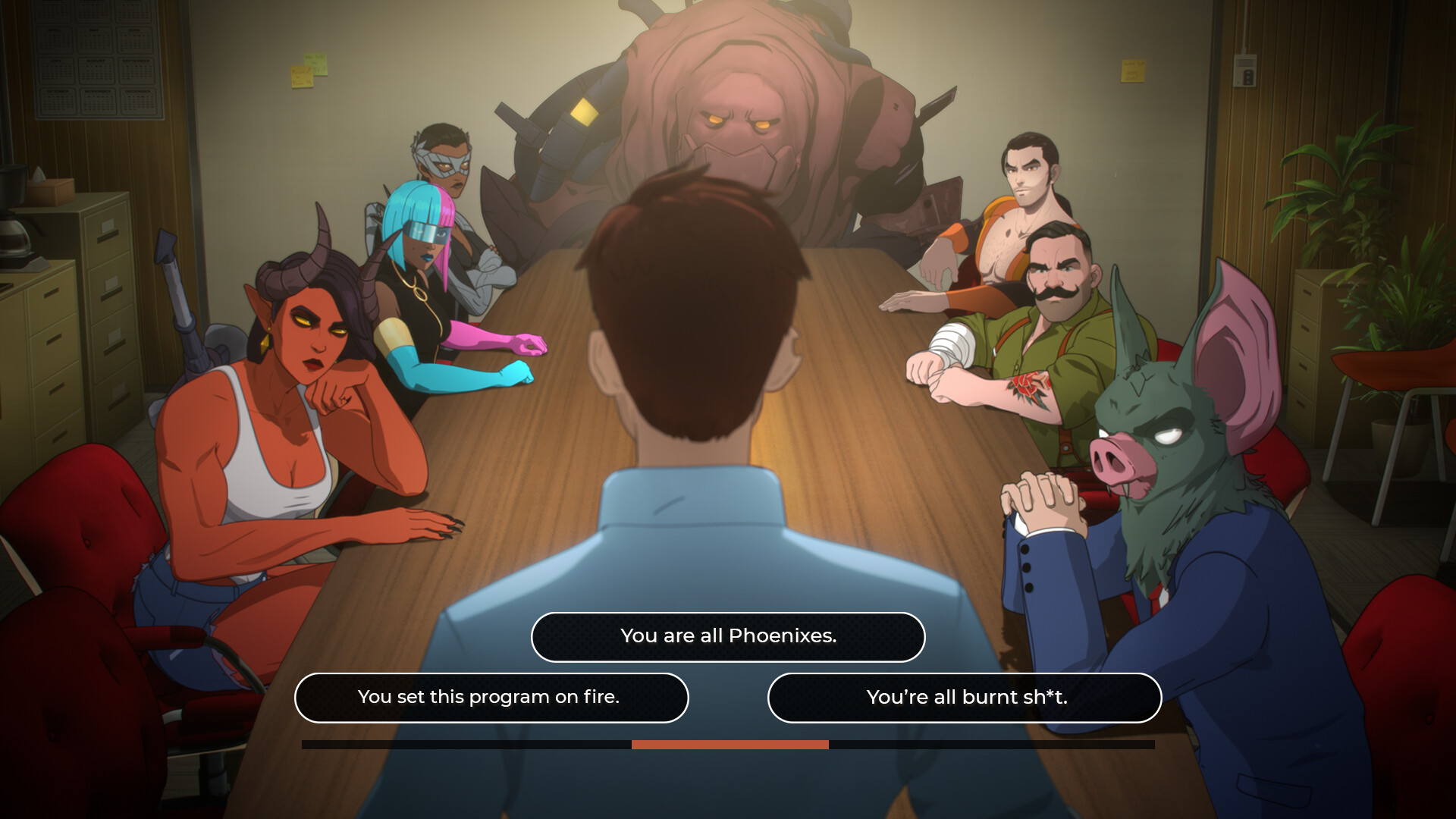
Split into two segments, Dispatch is part animated QTE tale and part gameplay that mirrors This is the Police. During the narrative/QTE sections, it’s obvious what you need to do. You’ll hit buttons that appear on screen or make choices that could affect the story. This is very typical of games like The Wolf Among Us or The Walking Dead, and honestly, many of the bigger choices appear near the finale. That isn’t to say earlier episodes don’t matter—be prepared to lose characters/friends—but Dispatch really takes all your choices and slams you in the final episode. Thankfully, those choices lead to some incredible variant endings.
When you aren’t guiding Robert’s life and his romances—you can romance two specific females—you’ll be doing your job as a dispatcher. This is the main gameplay, where you lead a team of former villains—dubbed the Z Team—now turned heroes, and must send them to appropriate missions. Each mission lets you choose who to send and how many. Not every hero is the same. Some are smart but lack combat ability, while others are strong but lack speed or decision-making. You’ll need to learn each hero and send them thoughtfully. Failing missions can lead to injuries or making them unusable for the rest of the episode.
I really loved the dispatch element behind this game. Take Sonar, a bat-like creature—he’s smart but changes into a more aggressive form after being dispatched. Meanwhile, Punch Up, the short brawler, is strong and passionate in a fight but lacks smarts and speed. Incidents sometimes play out differently depending on who you send, and missions may be easier—or harder—based on your choice. There is some RNG since incidents resolve with a percentage meter, but it still depends heavily on your chosen hero.
You can level up heroes after several successful missions, giving them better stats, but ultimately you must learn how they work, who they pair best with, and what they can and can’t do. You’re also given perks to support your team, like healing them if they fail or even reviving them—but these are limited per dispatch.
One of the weaker additions—though not entirely unenjoyable—is the hacking mini-game. Robert can occasionally join the action by hacking, where you control a node and guide it through other nodes to reach the central point. These puzzles can be tough and sometimes annoying, especially when aiming for perfect episode scores. Still, they don’t ruin the experience.
No spoilers, but the ending is where Dispatch shines like the sun. Many Telltale games struggled with making endings feel truly divergent based on choices. I feel Dispatch finally nails the formula those games missed. Who you romance, who you side with, and how characters feel about you all shape impactful final scenes. I do wish there were a few more big changes in a couple episodes, but that’s me being greedy. With the number of decisions and variations, Dispatch is great.
Graphics

Mirroring an animated film, Dispatch is gorgeous and every episode looks even better than the last. The beautiful character models, stunning backgrounds, and jaw-dropping action scenes prove you don’t need a massive studio to make something incredible. AdHoc has worked on comic-book-style games before, but Dispatch is on another level. Friends of mine watched playthroughs because it looks like an actual movie divided into eight parts. Visually, Dispatch is perfection—I couldn’t find a single flaw.
Sound
Dispatch looks perfect—and sounds perfect. The voice cast alone deserves an award. Robert is voiced by Aaron Paul (Breaking Bad), Invisigal by Laura Bailey, Punch Up by Jacksepticeye (Sean McLoughlin), and Sonar by Charles White Jr. (MoistCr1TiKal). Other big names appear too: Alanah Pearce, Matthew Mercer, Travis Willingham, Liam O’Brien, Erin Yvette, and even rapper Yung Gravy as Golem. Dispatch’s voice acting is unbelievable.
The OST is fantastic too. Most tracks are indie or lesser-known, but they fit the themes perfectly. Some episodes even end with different songs—like anime ED variations—and even the silly tracks worked surprisingly well.
Story

I’ve played 90% of Telltale’s catalog, and while some stories are legendary—The Walking Dead, The Wolf Among Us—others are simply okay. None of them, though, even touch how excellent the story is in Dispatch. As a comic book fan and nerd, I’m hyper-critical of superhero stories. They can be cliché, predictable, and overly simplistic. Dispatch has familiar tropes, but they’re presented in a much more grounded and relatable way.
The balance between comedy and dark themes is fast, sharp, and surprising. I was consistently on the edge of my seat, wondering how scenes would unfold, and even when events diverged from my expectations, I never lost my smile. From episode 1 to episode 8, Dispatch delivers a stellar narrative.
Overall Impression
I tried really hard not to gush during this review…pretty sure I failed. But I won’t apologize. Dispatch is phenomenal. Even the few issues I had didn’t ruin a single ounce of my experience. I don’t remember the last time I beat an episodic game released weekly on its scheduled day. Dispatch shows that AdHoc may have a new name, but their talent is nothing new—and they clearly have a bright future.
Pros
- Incredible comic book story with different paths and choices
- Engaging dispatch gameplay with high replayability
- Voice cast is beyond perfect
- Numerous reasons to replay with different routes
Cons
- Hacking mini-game is a bit annoying
Overall Score
10
Conclusion

When a game as incredible as Dispatch releases, it doesn’t make for an easy review. Part of me wants to just nerd out and shower it with praise, but that wouldn’t help readers unfamiliar with what this game is. Still, that should show you how much I loved it. Dispatch is one of those games you experience…and then experience again to see every possible variation. I already started my second full playthrough just to catch all the differences and alternate endings. I can’t recommend Dispatch enough. AdHoc Studio—your team is as incredible as the heroes within this game.
—Aaron