Goblin Company Review

“All in a Goblin’s day of work”
Introduction
Work is a genuinely tiring and sometimes dangerous endeavor — depending, of course, on what kind of work you do. When I was a kid who occasionally played outside, I’d imagine myself digging up buried treasure or helping carve a tunnel that everyone could use. This resulted in a lot of unexplained holes in the yard — I blamed the dog frequently — and confirmed early on that I would never be a miner. Thankfully, Goblin Company by developer BitBorne Studio has given me two things I genuinely love: fantasy and destroying stuff. In this goblin-themed mining game, your objective is simple — mine. That’s it. I mentioned earlier that work can be dangerous, and for these goblins it absolutely will be. Fortunately, anime and books have taught me that goblins exist in virtually infinite supply, so losing one or two along the way really isn’t that tragic. Here’s our Goblin Company review for PC! Thanks to BitBorne Studio for the review copy!
Gameplay

As a goblin employed by a company that is absolutely looking out for your best interests, your job is to mine — and mine — and mine some more. Gather jewels to make the company wealthier so you can unlock more goods to make the company even wealthier. Goblin Company reminds me a little too much of reality in hindsight.
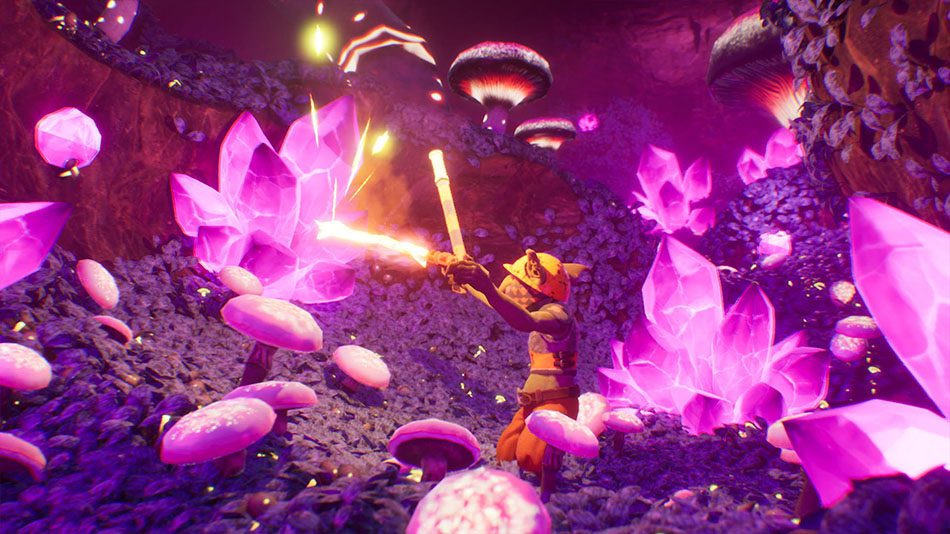
But I digress. The main goal, whether you’re playing solo or with friends, is to mine — using various tools and blasting everything that isn’t a precious, value-bearing rock. You start with a single gun that serves two functions: a standard mode for destroying low-tier terrain and rocks, and a red mode used to kill monsters — these mines are very much not safe — weld objects, and break specific rock types. As you progress, you’ll unlock new guns and upgrades that make mining faster and more lucrative. Various consumable drinks also offer temporary boosts — restoring health, revealing hidden objects, or enhancing your vision. These tools aren’t optional extras; they’re genuinely necessary to keep pace with the demands of the mines.
I’ll be upfront: the first hour of Goblin Company is pretty arduous. I spent a lot of time blasting walls and dying to lava-filled pitfalls or the encroaching darkness that consumes you if you forget your torches. But after settling in, Goblin Company became something I’d describe as fun — if a touch mind-numbing. It reminded me of PowerWash Simulator in the best possible way. There’s no ticking clock, no boss bearing down on you — just you and your mining, which is oddly peaceful once you embrace it.
The game does open up as your resources grow. Mining carts can be chained together into long trains for efficient crystal hauling, laser machines can be mounted on carts for added destructive power, and how you lay your rail tracks can meaningfully affect how much walking your poor goblin feet have to do. Creativity matters — but the system does have its limits in terms of what you can actually build and configure.
If aimless crystal gathering starts to wear on you, main objectives are available via the compass. These give you a destination, but how you navigate there safely is entirely up to you. Like Minecraft, blasting a laser straight through a wall is often the fastest route — but if you’re not paying attention, you might discover too late that your floor is gone and the next stop is a lava pool. Death respawns you as a new goblin — complete with a goofy new randomly generated name — but it also costs you everything you were carrying that wasn’t already in a cart or shipped back to base.
The biggest flaw in Goblin Company is that what you’re doing in hour one is essentially what you’ll be doing hours later. Building cart systems is genuinely fun and allows for some creative track layouts, but the core loop of finding ores, nabbing upgrades, and shooting anything that moves reveals itself early and doesn’t evolve much from there. Even the larger enemies go down the same way — shoot them. If the gameplay loop doesn’t click for you in the first hour, it won’t click later.
Co-op could help in theory, but I think it depends heavily on who you bring. I played solo for this review, and I suspect that’s actually the stronger mode — Goblin Company is best approached as a game you can zone out with, work your upgrade loop, and just mine until the veins run dry. Repetitive, yes. Oddly relaxing, also yes.
There’s also a permadeath mode for those who want a real test of nerves — but I’d strongly recommend skipping it unless you’re a genuine masochist. You will die to random enemies, invisible dark pits, and deeply unfair environmental hazards. I once died because my cart accelerated into a portal I was never supposed to use. I did rage — a little. You’ve been warned.
Graphics

Visually, Goblin Company is pretty solid given its scope. Despite being set entirely underground, the large-scale map offers detailed environments and surprisingly colorful, diverse areas to excavate your way through. I won’t claim it’s pushing any graphical boundaries — it’s no Minecraft in terms of visual ambition — but for what it delivers, the presentation is clean and I had very little to complain about. Maybe a touch less green overall would be nice, but then again — goblins are green, so fair enough.
Sound
Games like Goblin Company usually have the kind of music I mute within the first five minutes at record-breaking speed. Surprisingly, that didn’t happen here. Despite the occasional irritating track, Goblin Company‘s OST is oddly enjoyable — simple musical notes and lighthearted sounds that actually helped me lose myself in the mining loop. It took a while before I grew tired of the rotation, and even then there were tracks I didn’t mind hearing loop. I also love the goofy sound effects goblins make when they get hurt or meet their end — it gave me the same energy as the Grunts in Halo or various creatures from Star Wars. Little moments of charm that go a long way.
Overall Impression

There were moments writing this review where I had to stop and check whether I was expressing love or frustration toward Goblin Company — because honestly, I feel both. Mining, building elaborate cart systems, and exploring the depths were genuinely fun in stretches. But extended sessions started to feel uncomfortably close to actual work. Goblin Company needed more meaningful objectives and a stronger reason to care about what you’re doing beyond the next upgrade. As it stands, this is a game built specifically for those who want to zone out and play something simple — not a bad thing at all, but not for everyone either.
Pros
- Build and customize mining cart systems at your own pace while hunting for valuable materials
- Simple mechanics that are quick to learn and even quicker to start enjoying
- An upbeat, silly but oddly enjoyable OST that fits the game’s personality perfectly
Cons
- What you’re doing in the first hour is exactly what you’ll be doing for the entire game
- Very little to engage with beyond breaking walls and locating gems and treasure
- Can start to feel like actual work during longer sessions — which is not the compliment it might sound like
Overall Score
7.0
Conclusion

Goblin Company is a fun, simple game at a fair price — and it’s great for anyone who just needs to switch off and exist in a game for a while. You’re not saving the world. You’re not building sky-piercing monuments. You’re mining rocks to find prettier, more valuable rocks — and somehow that’s its own kind of satisfying. It reminds me of work sometimes, but it also brings me back to a time when simple was enough. If you enjoy mind-numbing games like PowerWash Simulator, Goblin Company deserves a look — and at just $7.99 (rising to $9.99 when the sale ends), I’ve played far worse for far more money.