Final Sentence Review

“There can only be one typist”
Introduction
Last year I came across a game I saw dozens of content creators playing on TikTok and YouTube — Final Sentence by developer Button Mash. As a writer who types at a fairly respectable 90–110 words per minute on a good day, this indie game immediately appealed to me. You versus up to 40 other players, all typing random text and numbers on screen, competing to stay alive — miss too many keystrokes and you get closer to death. It proved to me that the Battle Royale genre still has room to evolve well beyond the flood of FPS and third-person shooters that currently dominate the space. Despite missing the initial launch window, I finally sat down with Final Sentence and here are my thoughts. Is it the typing game to end all others, or should we just dust off our Dreamcast systems and play Typing of the Dead? We find out in our Final Sentence review for PC!
Gameplay

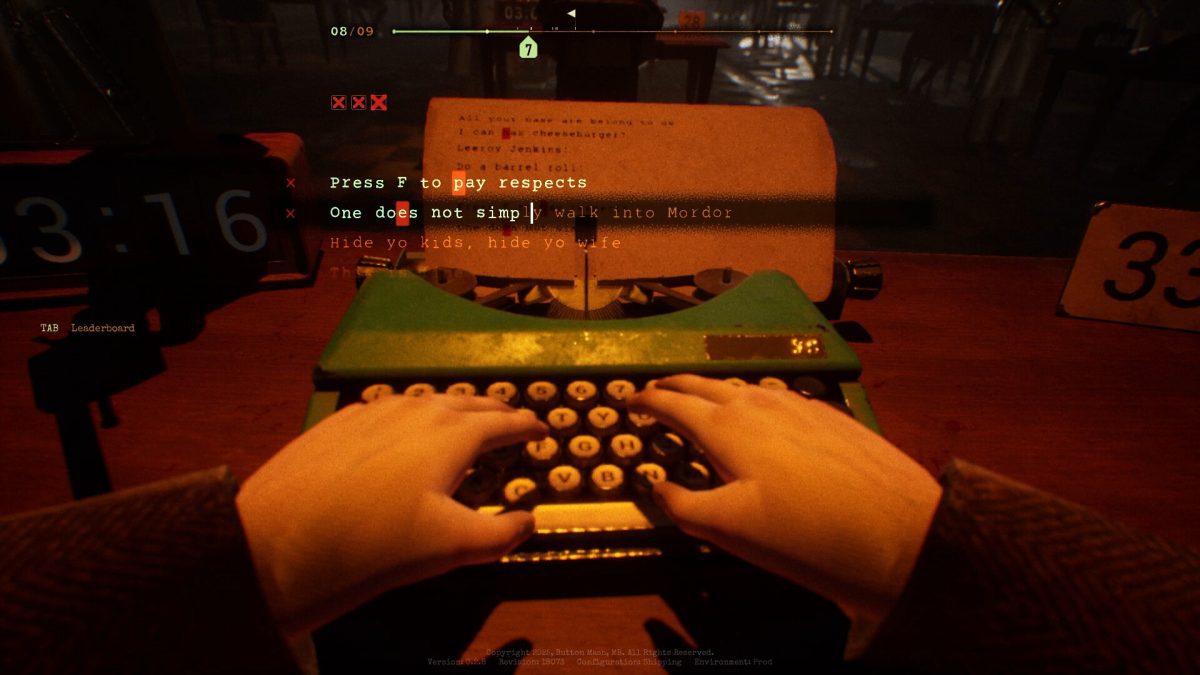
As I mentioned in my earlier demo coverage, Final Sentence is a refreshingly straightforward game. You’re dropped into a room with either bots or real players and forced to type. The specific objective shifts slightly depending on the mode, but the stakes are always the same — fail to outtype your opponents and a revolver bullet awaits your in-game character.
The full release expands significantly on what the demo offered with multiple game modes, each with enough variation to keep things interesting. Classic Battle Royale pits you against up to 40 players, where each mistake — limited to three per round — loads a bullet into a revolver. Each pull of the trigger might not kill you, but the odds climb with every bullet added to the chamber. This is the standout mode — the combination of time pressure and the sheer volume of opponents makes it consistently nerve-racking in the best possible way.
Two modes absent from the demo make their appearance in the full release: Duel and Knockdown. Duel strips it back to a pure 1v1 — fastest and most accurate typist wins. It’s fun and snappy, but it lacks the tension the main mode delivers. Knockdown, however, is a real blast. Eight players go head-to-head typing set phrases across rounds, with the slowest player eliminated each time until one remains. It’s quicker than Battle Royale but offers a meaningfully different experience.
Beyond the main modes, Final Sentence includes Training, AI matches, and Custom games. The first two are exactly what they sound like, while Custom lets you tweak the settings to your liking — great for challenging friends or honing your typing skills in a controlled environment.
The game does have a longevity problem, though. After several sessions across each mode, I found myself satisfied enough to step away for a few days. Final Sentence is the kind of game I’ll boot up when I’m bored, want to warm up my typing, or just need to know I can still compete — but will I be playing every day or even weekly? Probably not. What you see when you launch Final Sentence is what you get, and while there’s a solid amount of content here, the game does have a natural ceiling on how long most players will actively want to engage with it.
Graphics

Much like the demo, Final Sentence isn’t going to turn heads with its visuals. That said, it doesn’t look bad — it’s just deliberately simple. During matches, you’ll barely be looking at anything other than the words on screen, and that’s entirely by design. When you do take a moment to glance at the atmosphere and setting, there’s a genuinely unsettling quality to it — though it loses its novelty after a few sessions. For a small indie title priced at $9.99, I wasn’t expecting visual fireworks, and I’m not holding the simplicity against it.
Sound

Like the visuals, the audio doesn’t go overboard — but what’s here is excellent. The creepy voice over the loudspeaker announcing the start of each match is genuinely unsettling, and the layered ambient soundscape of typewriters clacking, missed keystrokes from other players, and the occasional gunshot as someone gets eliminated creates a tense, immersive atmosphere that keeps you locked in throughout. Final Sentence knows exactly how to use sound to build tension, and the restrained approach works in its favor — every audio cue matters.
Overall Impression
Final Sentence is, as I’ve said throughout, a very niche game — and I won’t pretend otherwise. The sweet spot audience here is die-hard typists who also happen to love the Battle Royale format, which is a narrow but enthusiastic group. The problem is that at its core, this is the entire game: typing. It’s fun and genuinely exciting in the right moments, but whether it can hold attention over the long haul is doubtful. That’s not a fatal flaw for a $9.99 indie title — but it’s worth knowing before you commit.
Pros
- Multiple game modes with enough setting variants to stay enjoyable across different sessions
- Excellent sound design and atmosphere that makes each match feel genuinely tense
- An affordable price point that makes it very easy to recommend for the right audience
- A surprisingly effective way to sharpen your typing skills under pressure
Cons
- Not much beyond typing against opponents — mini-games or additional variety would go a long way
- Still a very niche title with a limited ceiling on its potential audience
- Gets tiring after a few hours — not a game built for long play sessions
Overall Score
8.5
Conclusion

I gave the Final Sentence demo an 8.5 in my earlier coverage — and the full release earns that same score. The multiple game modes are a genuine improvement, and the issues I flagged previously are gone. But Final Sentence doesn’t climb higher than that either, and for the same reason it held steady: it’s a niche title that delivers a fun, exciting experience for as long as that excitement lasts — which, for most players, won’t be indefinitely. I’ll fire it up regularly enough to keep my typing sharp and scratch that competitive itch. But I’ll just as likely put it down for weeks at a time between sessions. If typing games are your thing, absolutely play it — just go in knowing exactly what you’re getting.


