4PGP Review

“Racing like it’s the 1990s again”
Introduction
When I was a kid, I loved playing old arcade racing games like Daytona USA — especially whenever I could track down the actual arcade cabinet. I wasn’t legally old enough to drive, so these games were my chance to get behind the wheel and cause maximum chaos without the insurance hikes or the points on a license I didn’t have yet. Old arcade racers are great fun — they may not have the depth of something like Forza Horizon or Gran Turismo, but they never needed it. That’s precisely why I was excited for 4PGP — the title isn’t exactly inspired, but the premise absolutely is — a game seemingly built around delivering a pure old-school arcade racing experience. After several hours behind the wheel, I can finally answer the question: is nostalgic arcade racing still worth your time in 2026? We find out in our 4PGP review for the Nintendo Switch 2! Thanks to developer 3goo K.K. / Vision Reelle for the review code!
Gameplay

4PGP doesn’t require a lengthy explanation. You pick a formula car, select a course, and put the pedal to the metal. It genuinely doesn’t get simpler than that. Unlike modern racing titles, 4PGP is all about bringing players back to the era when you had an acceleration button and a brake — with one modern concession in the form of a boost button. Out of the gate, it’s a lot of fun, and that wave of nostalgia hit me almost immediately when I dropped into my first circuit race against the CPU. The problems start to surface a few races in when you realize — 4PGP is a very, very simple racing game.
To be fair, old arcade racers were always meant to be simple. No need to tune tires or tweak internal systems — just you against the CPU or a friend. 4PGP captures that spirit well. Courses have you pushing 250 MPH through tight corners, avoiding walls that will either send you bouncing backwards — literally — or slow you down just enough to let the pack catch up. I promise you though: after two or three races, the only thing that changes is the growing realization that 4PGP might have already shown you everything it has to offer.
Kenji Sasaki — the legend behind Sega Rally and Ridge Racer — clearly put real care into making 4PGP feel accessible to everyone, and that’s simultaneously its greatest strength and its biggest limitation. You can ease in on Novice or pump the difficulty up to Expert and test your old-school reflexes — but regardless of the difficulty setting, the course, or the car you choose, 4PGP feels fundamentally the same. The ceiling is low, and you hit it fast.
That said, 4PGP does deserve credit for its couch multiplayer support — up to four players on the same screen, just like the good old days. I’ll always respect a game that recognizes people still want to play together in the same room in 2026 rather than always being online. On top of that, there are numerous gameplay modes to keep solo players busy, and a solid range of controller options — including gyroscopic controls — that give you a bit more feel over your car if you want it.
Graphics

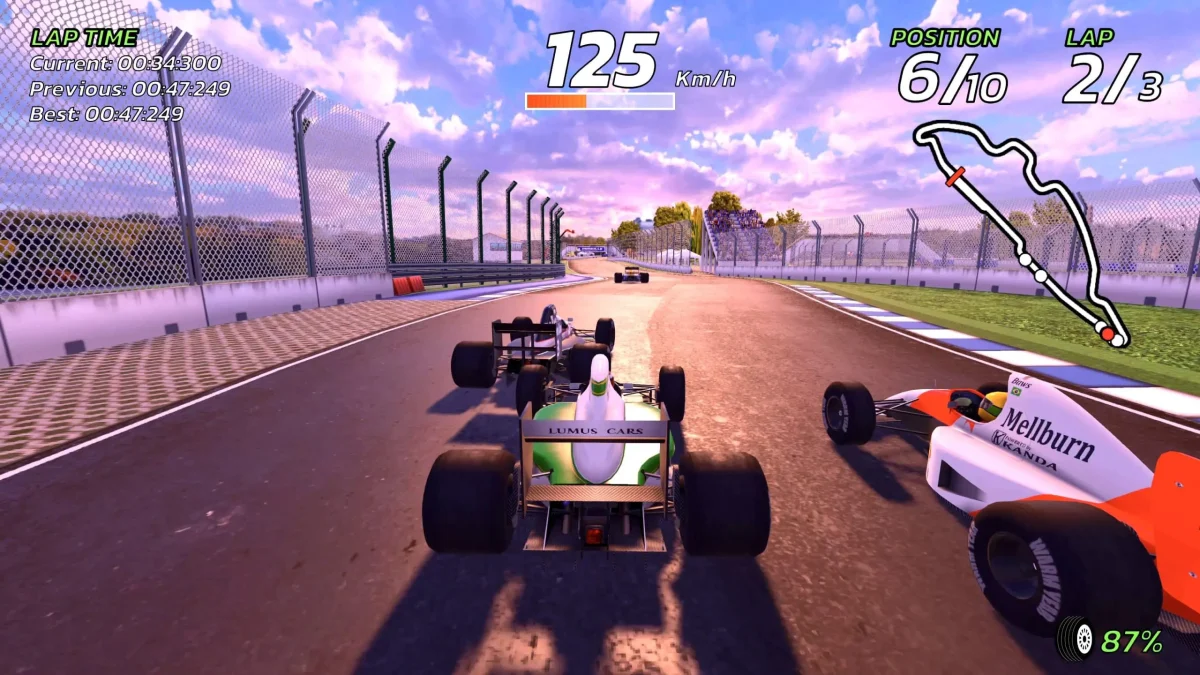
Visually, 4PGP looks like a 1990s arcade game — which is a feature, not a flaw, if that’s what you’re after. Cars share broadly similar designs differentiated mostly by color palette swaps, and the courses carry a similar aesthetic familiarity. There are at least several varied courses — a handful of which are unlocked through play — so you won’t feel like you’re running the same track on repeat forever. 4PGP isn’t going to push the graphical limits of any hardware it runs on, but if you want that genuine nostalgia trip, it delivers without missing a beat.
Sound
I was initially ready to call out 4PGP for its sparse music — there’s almost nothing during the early laps beyond the menu and race-start fanfare. Then I noticed: the music kicks back in after the second lap and plays continuously through the final stretch. And when it does, it genuinely gets you hyped. That’s thanks to yet another industry legend attached to this project — Tomoyuki Kawamura, known for his work on Virtua Racing, Tokyo Xtreme Racer, and Sega Rally. His fingerprints are all over what’s here. Like most of 4PGP, the sound design is simple — but it works exactly as intended, pushing you to fight for that first-place finish when the music finally hits.
Overall Impression

4PGP is old-school arcade racing done well — within its own deliberate limitations. Yes, it feels extremely dated, and yes, that’s entirely the point. Rather than trying to compete with the complexity of modern racing titles, 4PGP is simply trying to mirror the arcade racing experiences many of us haven’t enjoyed — or experienced at all — in decades. I’m genuinely not sure how younger gamers raised on Forza and Gran Turismo will respond to it, but old-school fans will find a fun, warm, and charming arcade racer packed into a small package.
Pros
- Old-school arcade racing in every sense of the word — an authentic throwback experience
- Numerous courses and cars to choose from, with several more unlockable through play
- Up to 4-player split screen for a genuinely nostalgic couch gaming session
Cons
- Extremely simple arcade racing that won’t appeal to everyone — especially modern racing fans
- Repetition sets in fast — harder than hitting a wall at 250 MPH
- Cars look largely identical with only minor cosmetic differences between them
Overall Score
6.5
Conclusion

4PGP brought me back in time — and for at least a little while, reminded me of simpler days spent pumping quarters into a cabinet and chasing that first-place finish. It isn’t the most complex racing game, and the audience it will resonate with is admittedly niche. But at just $12.99, it’s hard to say don’t bother. Go back in time and see how racing games used to feel versus how they work today. In some ways it’ll remind you how far we’ve come — but it’ll also remind you that even the old games still have something to offer, even now.