Disney+ Didn’t Save Star Wars. It Taught Fans to Stay Home.

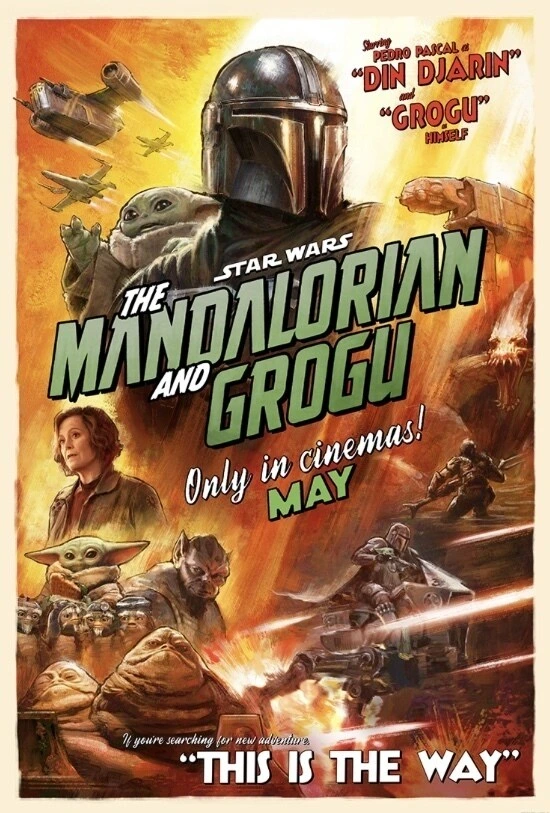
The Mandalorian & Grogu just posted the lowest opening weekend in Star Wars history. The numbers don’t lie — and neither does the decade of decisions that led here.
The final tally: $82 million domestic opening weekend. $102 million over the four-day holiday frame. $165 million globally.
Those are not the numbers of a triumphant return. Those are the numbers of the lowest-opening Star Wars movie in the history of the Disney era — lower than Solo: A Star Wars Story, the film so widely considered a financial catastrophe that it effectively killed the standalone spinoff format for half a decade. Solo opened to $88 million domestic in its opening weekend and $103 million over its own Memorial Day four-day frame in 2018.
Let that sink in. Disney waited seven years to bring Star Wars back to theaters. And when it did, it couldn’t beat the movie that became Hollywood shorthand for franchise failure.
Here’s the thing, though — this wasn’t a quality problem. The Mandalorian & Grogu earned an A- on CinemaScore — better than The Rise of Skywalker, which limped out with a B+ in 2019 while critics and fans actively feuded about whether it had ruined the entire sequel trilogy. Audiences who showed up for Mandalorian & Grogu loved it. The problem is that not enough of them showed up.
So why didn’t they? The answer is hiding in plain sight — and it has a Disney+ logo on it.
The Numbers That Tell the Real Story
To understand how far Star Wars has fallen as a theatrical proposition, you need to see the full arc of Disney-era box office numbers in one place:
| Film | Opening Weekend (Domestic) | Release Year |
|---|---|---|
| The Force Awakens | $247.9M | 2015 |
| The Last Jedi | $220.0M | 2017 |
| The Rise of Skywalker | $177.3M | 2019 |
| Rogue One | $155.1M | 2016 |
| Solo | $84.4M | 2018 |
| The Mandalorian & Grogu | $82.0M | 2026 |
That is not a gradual decline. That is a collapse. From The Force Awakens to The Mandalorian & Grogu, the franchise has shed $165 million off its opening weekend in just over a decade. More telling: there is a hard floor that appeared right around the time Disney launched its streaming service — and Star Wars has never climbed back above it.
The Rise of Skywalker in 2019, despite being a genuinely divisive film that landed with a thud critically, still opened to $177 million. That was the last theatrical Star Wars release before Disney+ became the franchise’s primary home. When the studio finally tried to bring it back to cinemas seven years later — with a beloved property and a beloved director — it got $82 million.
How Disney Built the Habit — Then Broke It
When Disney+ launched in November 2019, The Mandalorian was its killer app. The show was a phenomenon. Pedro Pascal’s stoic bounty hunter and his impossibly charming little green companion became the most talked-about thing on television — and Disney knew it. The Mandalorian wasn’t just a hit; it was proof of concept. Star Wars could work on the small screen. It could drive subscriptions. It could be a reliable content engine.
So Disney did what any media company does when it finds a working formula: it scaled it aggressively. What followed was a five-year flood of Star Wars content on Disney+:
- The Mandalorian Season 2 (2020)
- The Book of Boba Fett (2021–2022)
- Obi-Wan Kenobi (2022)
- Andor Season 1 (2022)
- The Mandalorian Season 3 (2023)
- Ahsoka Season 1 (2023)
- The Acolyte (2024)
- Tales of the Empire (2024)
- Skeleton Crew (2024)
- Tales of the Underworld (2025)
- Maul: Shadow Lord (2026)
Eleven productions in roughly six years. Some of them — like Andor — were genuinely exceptional television that elevated the franchise’s creative reputation. Others — like The Acolyte — were cancelled after a single season amid poor reception. Several landed somewhere in the muddled middle: watchable, occasionally great, rarely essential.
Here is the problem: the quantity didn’t matter as much as the conditioning. For half a decade, Disney trained Star Wars fans to experience new Star Wars on their couch, on demand, in their pajamas, without spending $18 on a ticket. New Star Wars arrived roughly every six months. There was always something coming. And it was all already covered by the Disney+ subscription people already had.
When you spend five years training an audience to consume your product one way, you cannot simply snap your fingers and convince them to consume it differently. The theatrical event-movie habit requires cultivation. It requires scarcity. It requires the feeling that this experience cannot happen anywhere else. Disney methodically dismantled all three of those conditions — then was apparently surprised when audiences didn’t sprint back to the multiplex.
The Solo Comparison Is More Damning Than It Looks
The industry’s instinct has been to frame Mandalorian & Grogu‘s opening as comparable to Solo — and technically, in raw numbers, that’s accurate. But the comparison is actually far more damning than it appears on the surface, for one key reason: Solo failed in a very different context.
Solo opened in May 2018 under genuinely difficult circumstances. It came out just five months after The Last Jedi, a film that had divided the fandom so sharply that some fans were organizing online campaigns against it. Release fatigue was a documented factor — two major Star Wars films in five months was simply too much too fast. The film also had a notoriously troubled production, with directors Phil Lord and Chris Miller fired mid-shoot and Ron Howard stepping in for reshoots. Trade journalists were writing about the chaos before the film even opened.
The Mandalorian & Grogu had none of those problems. It had a seven-year runway. It had a beloved director who built the show from scratch. It had the most universally adored character in the franchise’s recent history. It had strong reviews and an A- audience score. And it still couldn’t match what Solo did under crisis conditions.
That gap is not about the film’s quality. That gap is the price of five years of Disney+ conditioning.
The Quality Trap: When Good Enough to Love Isn’t Enough to Leave the House For
There is an uncomfortable truth buried in the CinemaScore data that Disney needs to sit with: the audience that showed up for The Mandalorian & Grogu loved it more than the audience that showed up for The Rise of Skywalker did.
The Rise of Skywalker — a film that opened to $177 million — got a B+. The Mandalorian & Grogu — a film that opened to $82 million — got an A-.
This means Disney did not have a product problem. The movie is good. It is, by the metric of people who actually watched it, the best-received Star Wars theatrical release in years. The studio’s problem is not that it made a bad film. Its problem is that it can no longer mobilize the casual audience — the families, the date-night couples, the culturally-curious people who don’t follow Star Wars closely but show up because the movie feels like an event — that once made these numbers enormous.
That casual audience doesn’t buy Disney+ specifically for Star Wars. They see a Star Wars movie is on Disney+ and they queue it up. They don’t feel urgency. They don’t feel the need to be part of a moment. They will get to it eventually — the same way they get to everything else in their streaming queue. The theatrical habit is gone for them because Disney never gave them a reason to keep it.
What Comes Next — and Why This Moment Matters
Disney has reportedly responded to the Mandalorian & Grogu results with measured optimism, pointing to the A- CinemaScore and noting the film’s leaner $165 million budget compared to the sequel trilogy’s bloated productions. Internally, the story being told is that this is a soft reset, not a catastrophe.
That framing misses the point. Budget discipline is not the issue. The issue is that a franchise that once commanded $247 million in a single opening weekend — with The Force Awakens in 2015 — is now fighting to clear $100 million with one of its most beloved characters and a respected creative team. The trajectory is down, and the cause is structural, not creative.
There is a version of this story that ends well. Andor Season 2 is arriving later this year and is expected to be among the best things Disney+ has ever produced. If the studio resists the temptation to flood the market again, if it treats theatrical releases as events rather than content drops, if it rebuilds the scarcity that makes people feel like they need to be in a theater — it can recover. The audience affection for Star Wars is not gone. The A- proves it.
But affection and urgency are different things. And right now, Disney has the former without the latter.
The numbers from this past Memorial Day weekend are not a one-week story. They are the receipt for a decade of decisions. Disney built something remarkable with The Mandalorian. Then it loved it to death on streaming, and called that a strategy.
The galaxy far, far away is still there. The question is whether audiences still feel like they need to go there — or whether they’ve learned to wait.