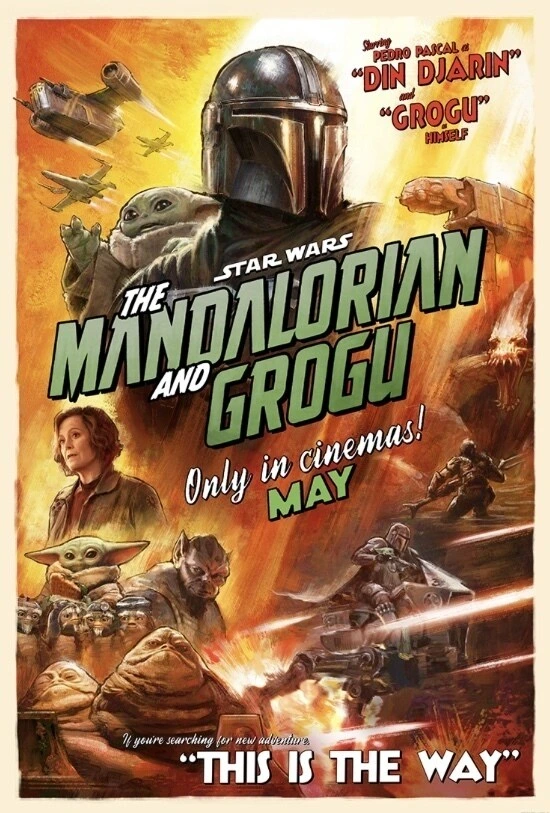
The Mandalorian Movie Looks Like a Streaming Show, And That’s the Problem

When the first footage from The Mandalorian and Grogu screened in April, the reaction from critics wasn’t negative exactly. It was something more uncomfortable: familiar. The tight framing. The shallow backgrounds. The muted palette of dark greens, grays, and beige. The way every shot felt sized for a 55-inch living room TV rather than a 70-foot screen. Journalist Jake Kleinman put it plainly — the opening 15 minutes felt “more like a generic streaming show or video game than a cinematic experience.” Others called it indistinguishable from a Disney+ episode. One headline, only half-joking, called it a “Netflix show.”
The film drops May 22 — Star Wars’ first theatrical release since The Rise of Skywalker in 2019. Disney has a great deal riding on it. Early tracking numbers put the opening weekend somewhere between $71 million and $100 million over the four-day Memorial Day frame — and those projections suggest the studio may be running headlong into a problem it built for itself. When you spend half a decade teaching your audience to experience a franchise on demand, for free, in their pajamas, getting them to pay $20 for a theatrical ticket requires more than just a bigger screen. It requires a fundamentally different kind of film.
The Mandalorian and Grogu may not be that film.
The Hole Disney Dug Itself Into
To understand how Star Wars ended up here, you have to go back to 2018 and the failure of Solo: A Star Wars Story. Despite a recognizable character, a capable director in Ron Howard, and the full weight of the Disney marketing machine, Solo opened to $84 million over three days — the worst Star Wars debut in the Disney era — and ultimately lost the studio an estimated $103 million after a $443 million production and marketing bill. The lesson Disney took from Solo was that audiences were fatigued by theatrical Star Wars. The lesson they probably should have taken was that audiences were fatigued by unnecessary Star Wars stories — ones that felt like filler rather than events.
Instead of addressing the creative problem, Disney addressed the distribution problem. Star Wars moved to Disney+ with The Mandalorian in 2019, and for a while, it worked beautifully. The show was sharply written, visually inventive within its budget, and introduced Grogu — “Baby Yoda” — a cultural phenomenon that proved the franchise still had pop-culture juice when it wasn’t trying to wrap up a nine-film saga. The Book of Boba Fett, Obi-Wan Kenobi, Andor, Ahsoka followed. Disney+ became the home of Star Wars, and streaming became the grammar of the franchise.
That grammar is now the problem.
What “Cinematic” Actually Means — And Why It Matters
The criticism that The Mandalorian and Grogu “looks like a TV show” is easy to dismiss as snobbery — prestige television has matched or exceeded theatrical film quality in countless cases. But the critics pointing at this footage aren’t complaining about production values. They’re identifying something more specific: a visual and narrative language that was designed for intimate, episodic consumption and has not been successfully scaled up to theatrical event filmmaking.
The differences are real and technical. Theatrical cinematography typically uses wider aspect ratios — 2.39:1 is the cinematic widescreen standard, versus the 2:1 or 16:9 of most streaming content — shallower depth of field to create visual separation, dramatic lighting contrast with deep shadows that give images weight and dimension, and slower editorial rhythms that let individual shots breathe. These aren’t arbitrary stylistic choices. They’re tools calibrated specifically for a dark room, a massive screen, and an audience that has committed two-plus uninterrupted hours to a single experience.
The Mandalorian TV series was shot primarily using the Volume — a massive LED stage technology that projects photorealistic backgrounds behind actors, eliminating the need for location shoots and practical lighting. The results were impressive for television and genuinely revolutionary for the show’s budget level. But the Volume has a signature look: lighting that’s slightly diffuse, backgrounds that lack the parallax depth of real environments or traditionally composited VFX, and a visual flatness that reads as warmth and intimacy on a small screen and as cheapness on a large one. Reviewers watching the Mandalorian and Grogu footage aren’t imagining things. They’re perceiving the physical artifacts of a production approach that was optimized for the wrong destination.
The Star Wars Box Office Trajectory Is a Warning
The box office history of Star Wars under Disney tells a story of diminishing returns that makes the Mandalorian film’s projections even more alarming in context. The Force Awakens (2015) was a genuine phenomenon — $2.07 billion worldwide, $500 million in net profit. Rogue One (2016) cleared $1.06 billion and $258 million in profit. The Last Jedi (2017) earned $1.33 billion but generated the kind of audience controversy that visibly eroded patience for what came next. Then came Solo and its $103 million loss, followed by The Rise of Skywalker — a film that technically crossed $1 billion worldwide but returned a paper-thin $48 million profit on $594 million in costs, a figure that looked more like a brand obligation being honored than a healthy theatrical event.
Disney’s response to that decline — pivoting the franchise to streaming — bought time and rebuilt goodwill. But it also meant the theatrical Star Wars audience went six years without a film. An audience that doesn’t go to theaters to see your franchise is an audience that has learned, behaviorally, not to go to theaters to see your franchise. Rebuilding that habit requires giving people an experience they genuinely cannot get at home. The early footage of The Mandalorian and Grogu does not appear to be that experience.
Current projections — between $71 million and $80 million for the three-day opening, possibly reaching $100 million over the four-day Memorial Day frame — would put the film at or below Solo‘s opening, the franchise’s previous benchmark for disappointment. The one mitigating factor is budget: at a reported $166 million, Mandalorian and Grogu is the cheapest Disney-era Star Wars film by a significant margin, compared to Solo‘s bloated $300 million tab. A modest opening is survivable at that cost. But profitability is not the same as franchise health — and a Star Wars film that opens below Solo sends a signal the studio will find very hard to spin.
Marvel Already Learned This Lesson Badly
Star Wars is not the only Disney franchise navigating this problem. The MCU spent those same years flooding Disney+ with series — WandaVision, Loki, Hawkeye, Ms. Marvel, She-Hulk, Moon Knight, Secret Invasion, and more — that ranged from genuinely excellent to outright perfunctory. The cumulative effect was an audience that grew accustomed to Marvel as ambient content: something to have on while doing other things, consumed in 40-minute episodes at their own pace and quickly forgotten. When those same audiences were then asked to show up for theatrical events that required familiarity with streaming storylines to make any sense, they largely didn’t bother.
The Marvels (2023) earned $206 million worldwide — an MCU nadir. Ant-Man and The Wasp: Quantumania opened to just $106 million domestically. Critics and analysts pointed to streaming fatigue, narrative oversaturation, and — crucially — films that felt like extended streaming episodes rather than theatrical spectacles. Films like Thunderbolts and Eternals, whatever their individual merits, generated the specific criticism that they would have worked better as Disney+ series. That criticism is not a compliment. It means they lacked the scale, urgency, and visual ambition that justifies the theatrical format.
Disney appears to have partially absorbed this lesson on the Marvel side — Avengers: Doomsday is being positioned as a theatrical event on a scale the streaming shows deliberately withheld. Whether they’ve absorbed it on the Star Wars side is considerably less clear.
The Deeper Problem No One Wants to Say Out Loud
There’s a harder question sitting underneath the cinematography debate, and it’s this: has Disney’s streaming strategy structurally undermined its ability to make theatrical blockbusters feel like events?
The theatrical experience has always been partially psychological. You pay more. You travel somewhere specific. You sit in the dark with strangers. And you watch something that feels — by its scale, its sound, its visual ambition — like it was made for exactly that context. The bargain works because the content delivers on the premise. When the content looks and feels like something you could watch at home, the bargain breaks down. Not because home viewing has gotten better — though it has — but because the implied promise of the theatrical ticket has been violated.
Disney built its streaming empires on both the Star Wars and Marvel sides by offering fans more: more story, more characters, more lore, more access. The problem is that “more” and “event” are fundamentally incompatible. Events are scarce. Events are things you cannot get anywhere else. Events demand something of you. A franchise that releases content every few months, across multiple platforms, with interlocking storylines that require homework — that franchise is not positioning itself as an event. It’s positioning itself as a subscription service. And subscription service content, however well-made, does not feel like something you need to see on a 70-foot screen at 10 PM on opening night.
The Mandalorian and Grogu may well be a good movie — the reviews that actually matter are still weeks away. But the footage that exists, the tracking numbers in hand, and the six-year theatrical absence of the franchise all point toward the same structural issue: Disney taught its audience to watch Star Wars from the couch. Convincing them to leave it is a harder sell than a new trailer can fix — and it may require a more fundamental rethink of how the studio uses its theatrical window than any single film can deliver.