Perfect Tides: Station to Station Review
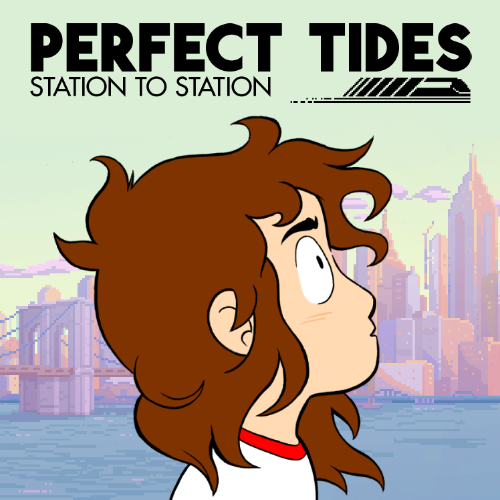
The growth of a writer
Introduction
As a writer, I can spend all day telling you that our minds work very differently than most. I’m not going to sit here and say I’m smarter or speak more eloquently, but writers just see the world through a different lens. I can look at a street sign and think of a million stories about it—what the sign has seen, who made it, and how it could outlast a world-ending event involving space aliens or AI-crafted robots. Writers are…weird, but I never said being weird is a bad thing.
When I come across a game that speaks volumes to me as a consistently evolving writer, I dive in without hesitation. Perfect Tides: Station to Station is a sequel to Perfect Tides—released in 2022—following the now 18-year-old Mara and her continuing journey as a teen writer entering adulthood. I never played the original game from developer Three Bees, but I quickly familiarized myself with its quirky point-and-click style and prepared myself for the sequel.
Is this sequel an evolved narrative, or is it, as one character in the game suggests, true that “by its very nature, a sequel dilutes the power of the original”? In other words, is it doomed to fall just a bit short? I’m about to find out in my review of Perfect Tides: Station to Station on PC. Big thanks for the review code courtesy of Three Bees.
Gameplay
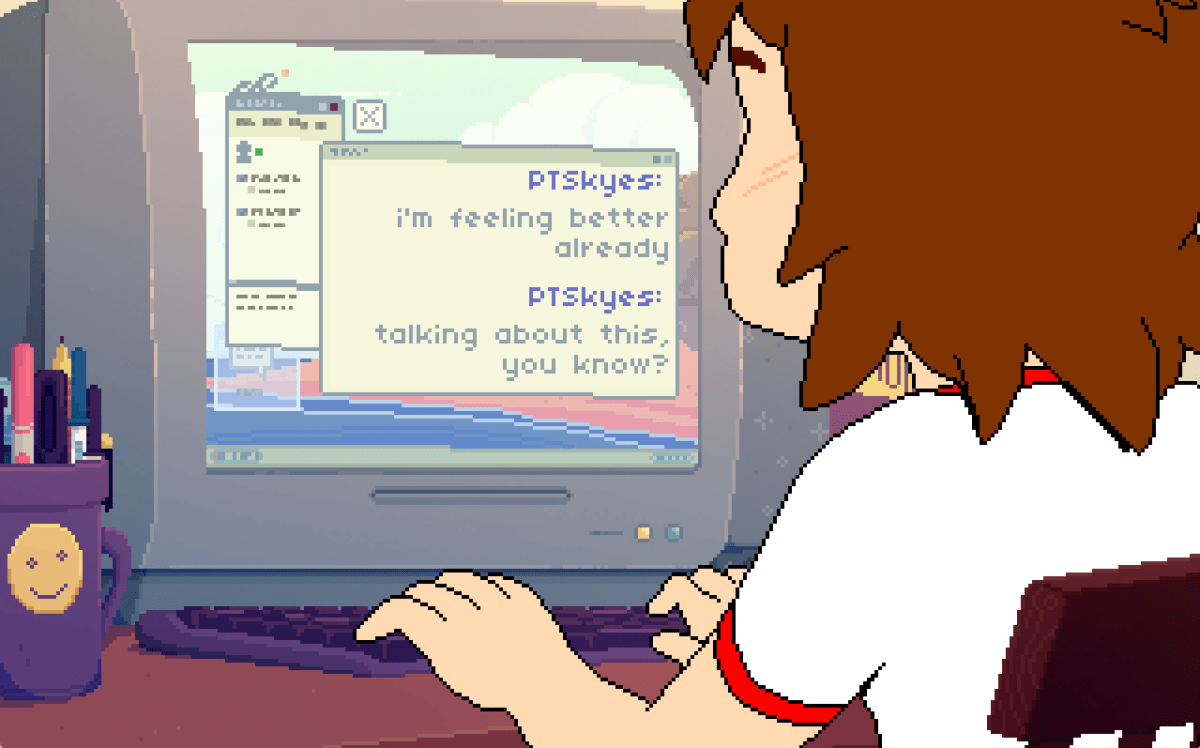
Much like its predecessor, Perfect Tides: Station to Station is a 2D point-and-click adventure that feels refreshingly retro in the modern gaming landscape. Players step into the role of Mara Whitefish, now a college student and aspiring writer. This isn’t an action game or a disguised RPG; instead, it’s an experience designed to explore the early stages of adulthood and the uneasy transition away from teenage comfort zones.
Most of the gameplay revolves around clicking to move Mara through environments, though players can also use arrow keys or a gamepad. What elevates Perfect Tides: Station to Station are the small but meaningful systems layered on top of its simple foundation. Mara’s old Nokia-style phone is more than a contact list—it acts as a way to compile conversation topics. As Mara observes her surroundings, she gains new discussion points that can unlock additional dialogue or progress the story.
The game also incorporates traditional point-and-click mechanics like dragging items and navigating areas via arrows. These systems are simple, intuitive, and never overly obtuse—a welcome change from point-and-click games that often overcomplicate their puzzles.
One standout feature is the writing assignment mechanic. As a college student, Mara must complete writing assignments with deadlines. Players can select different topics for these assignments, resulting in varied outcomes. Some combinations lead to stronger writing, while others produce humorous or awkward results, often reflected in Mara’s reactions.
Reading also plays a key role. Players can collect books and magazines—limited to five at a time—and read one per day to expand Mara’s worldview. Books can be traded or discarded to make room for new ones. These elements aren’t strictly necessary, but they add depth and function as light collectibles that enrich the experience.
Graphics

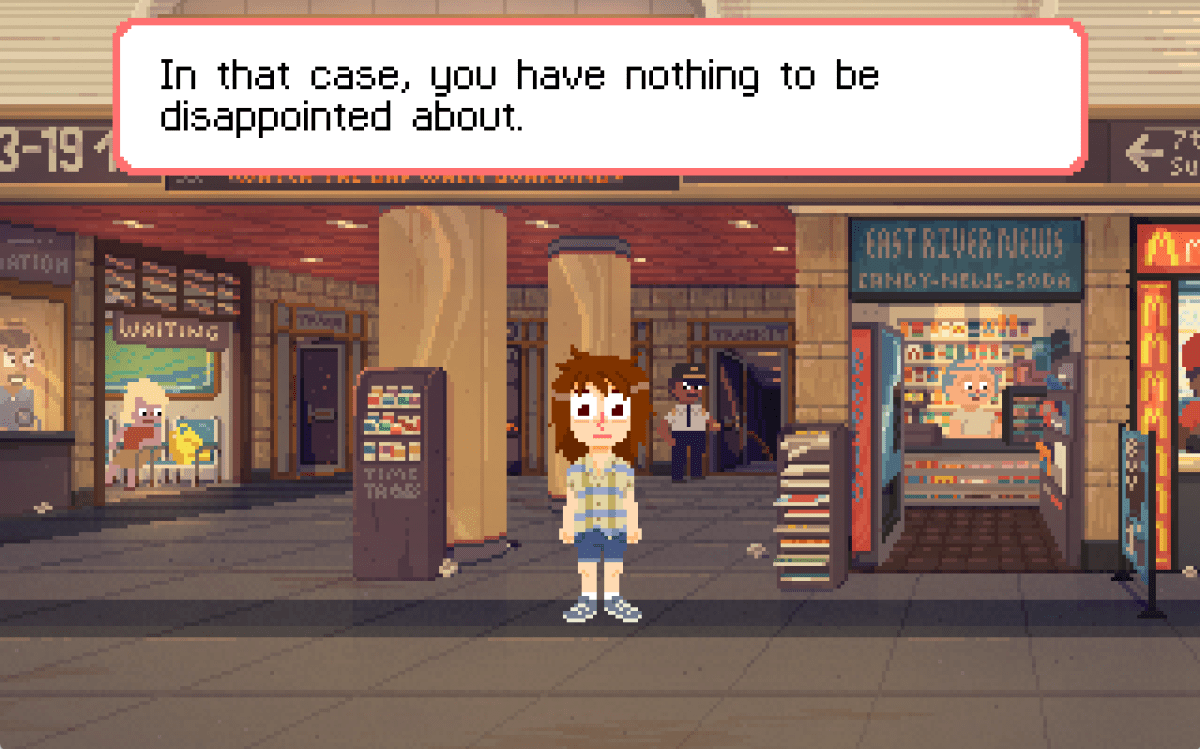
Perfect Tides: Station to Station is a noticeable visual improvement over the original game. Retaining its hand-drawn, cartoon-inspired style, the sequel often shifts from simple 2D sprites to more elaborate illustrations when the moment calls for it. The backgrounds are packed with small details and real-world references, from posters for The Matrix to book covers that firmly ground the story in its era.
Environments feel inviting and encourage exploration, whether to read Mara’s internal commentary or simply enjoy the clever writing. Some locations—even within this fictional setting—strongly resemble real-world places, particularly areas that feel unmistakably inspired by New York and Long Island. While the art style may not appeal to everyone due to its simplicity, it fits the tone of Mara’s story perfectly and adds to the game’s overall charm.
Sound
I will never complain about a game that leans into lo-fi or minimalist instrumental music. Perfect Tides: Station to Station uses its soundtrack masterfully, shifting seamlessly between mellow, thoughtful, and emotionally resonant tones. Whether Mara is wandering the city or sitting quietly in a library, the music always feels appropriate.
There’s no voice acting, but the soundtrack alone carries the emotional weight of the narrative. The music ebbs and flows naturally with the story, enhancing both its comedic and darker moments without ever becoming intrusive.
Story
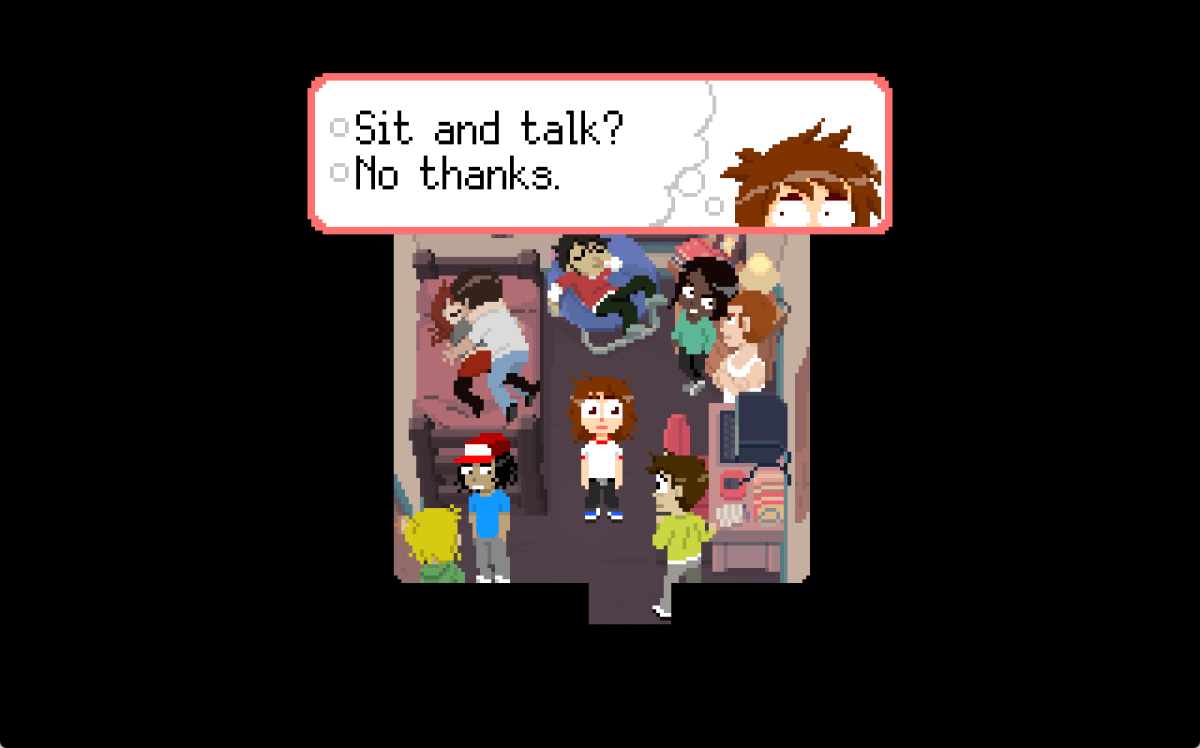
For those familiar with the first game, Perfect Tides: Station to Station continues Mara’s personal growth as she enters college. She’s still insecure, still searching for her place in the world, and still driven by her desire to write. These struggles feel authentic and deeply relatable.
What makes the story shine is how grounded it feels. Despite being fictional, Mara’s experiences mirror real life in ways that go beyond emotion alone. The game is filled with pop culture references—from Golden Boy to The Matrix Reloaded—that make the world feel lived-in and believable. The narrative captures the mindset of a young writer navigating identity, ambition, and adulthood, and it stays with you well beyond the credits.
Overall Impression
Perfect Tides: Station to Station may appear to be a simple point-and-click adventure, but beneath that surface lies a deeply personal and engaging experience. With its relatable storytelling, charming visuals, and thoughtful gameplay systems, it succeeds in telling a story many players will see themselves reflected in.
Pros
- Great lo-fi music that perfectly matches each scene
- Simple yet engaging point-and-click gameplay
- Down-to-earth humor and writing that feels authentic
- No frustrating puzzles—exploration is always rewarding
Cons
- Art style may not appeal to everyone
Overall Score
9.0
Conclusion
I may be in my mid-thirties now, but I remember my teenage years vividly—the uncertainty, the shifting friendships, and the uneasy steps toward adulthood. Perfect Tides: Station to Station captures that transition flawlessly, especially through the lens of an aspiring writer. Its intuitive gameplay and emotionally honest narrative make it a standout indie experience.
I sincerely hope Three Bees continues to create games, whether within the Perfect Tides universe or beyond. Their storytelling voice is special, and I can’t wait to see what they create next.