Thaumazein: On the Movements of the Mind
Thaumazein (θαυμάζειν) – verb: Ancient Greek word meaning “to wonder,” “to marvel,” or “to be amazed.” It is the origin of philosophy according to Plato and Aristotle.
Pause for a moment. Step back. Take a deep breath. Look up at the sky. Listen to the wind blow through the leaves. Feel the ground under your feet. Isn’t it a miracle that our world exists, that we are positioned in this time and place, whether it be by a higher power or by chance, and that we have the ability to think and create? And the ability to pass down that knowledge? Throughout history, countless people, cultures, and customs have been formed by looking at the world around us. Every corner of the globe hosts a unique perspective on its own unique types of people. Legends and myths boast about fantastical adventures. Songs celebrating culturally relatable heroes. Paintings and pottery bearing a resemblance to the common and royal folk. The Earth is bound by its vibrant inhabitants.
But time moves forward, leaving some civilizations behind, while springing forth new ones as we grow in the knowledge of the world around us. As we continue to move further into the 21st century, our culture continues to develop based upon the past, but with an outlook on the future. Just 20 years ago, what was considered “nerd culture” is now more popular than ever. Things like video games, comic books, anime, and manga are seeing hit after hit among the people of this generation, and they, too, will be passed down as well.
What caused this change? Why do cultures experience change in the first place? Did past civilizations experience generational shifts? Surely they must have, that’s why they’re dead. Were they afraid of waves of change, as some still are today? Why should we care? Why do we care? They are in the past; it does not matter now, right?
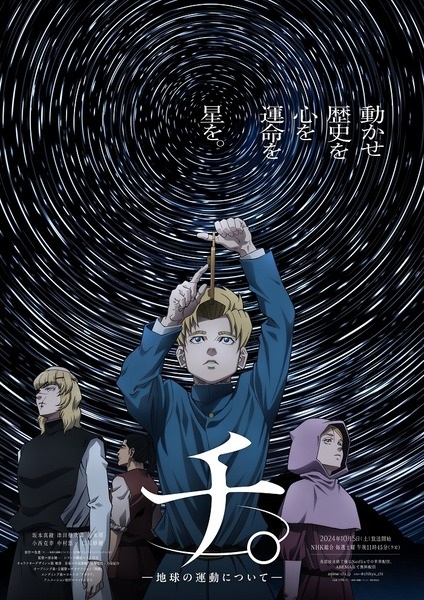
Ironically, an answer can be found in a piece of culture from our day: an anime titled Orb: On the Movements of the Earth.
Orb: On the Movements of the Earth is a seinen historical drama written and illustrated by mangaka Uoto. It was serialized in Shogakukan’s seinen manga magazine Weekly Big Comic Spirits from September 14, 2020, to April 18, 2022. Episode 1 of the anime under the same name was released on October 5, 2024, and completed its 25-episode run on March 15, 2025. Even though it was Uoto’s first anime adaptation, it was received with critical acclaim from both audiences and critics. The story revolves around the idea of heliocentrism, the belief that the Earth revolves around the sun, which, in the setting of 15th-century Poland, was just a belief. Yet, as you continue through the story, it evolves into something so much more impactful.
Rafal, a child prodigy studying theology, has a side interest in astronomy. He believes in rationality, that the only way to live life is to do what he is told to avoid useless arguments, to disregard personal interest if it conflicts with others. So, when his father tells him to quit studying astronomy, he does so, though reluctantly. Still, he stares up at the night sky, continuing to admire the stars.
Soon, he meets a heretic, Hubert. Hubert is a scholar and takes an interest in Rafal for his passion for astrology. Hubert’s eyes are failing, so he relies on Rafal to be his eyes. Though skeptical at first, curiosity gets the best of him, and Rafal agrees, though still being on guard and ready to alert the Church at any moment.
Night falls, and Rafal and Hubert meet up in a field. The sky is vibrant with the galaxy, and Rafal records what is asked of him. Suddenly, Hubert asks Rafal to draw a model of the universe in the dirt. Rafal obeys, though confused. Before Hubert, he draws the geocentric model of the universe, with the Earth at the center. Rafal explains that even though it is messy, with all the planets and celestial bodies each having different orbits around it, the model is highly accurate.
Then, Hubert takes a step back, breathes in deeply, and asks Rafal something that stops him in his tracks.
-
“Is this beautiful?”he asks.
Rafal ponders for a moment and responds, “Beauty is subjective.”
But Hubert retorts, “Do you think this is beautiful?”
Rafal stops again. After some analysis, he looks back at Hubert.
“No.” he replies.
Hubert breathes in deeply. “I do not wish to live in a universe that is not beautiful.”
But Rafal carefully explains that to put beauty before rationality is foolish, that the world operates best when the most rational outcome occurs. He explains that even though the movements of the stars are messy, they are what is rational.
-
“But what if rationality and beauty can become one?” Hubert asks.
“How?” Rafal replies.
“What if the stars don’t move?” Hubert says.
Rafal laughs. “That’s ridiculous!”
“But it’s not.” Hubert reaffirms.
“Then what is moving?” Rafal asks jokingly.
Hubert looks Rafal in the eyes.
“The Earth.” he says.
And from that moment, Rafal’s world turns upside down.
This scene, though highly paraphrased, is the beginning of a sequence of many events that occur in the story. Hubert explains to Rafal that because of heliocentrism, the world can be both rational and beautiful. Though with natural denial, Rafal continues to research that idea, and more and more evidence points to it being true. Astonished, Rafal starts to believe the words of Hubert, despite him being a heretic. He starts to notice the world around him as it becomes brighter. He is propelled by the inspiration and knowledge bestowed upon him.
Then, he looks up to the sky once again, finally understanding why he did so in the first place. This is just one example of the many times in the story where the idea of heliocentrism is something meaningful to every character. One simple idea imposed by another can change the course of people’s lives forever. They stare into the sky with wonder and newfound hope, that it is a miracle that this world exists the way it does.
Since the dawn of time, humanity has always been seeking answers. We are a curious species. We are a communal species. We need each other to live and grow; that’s how we were designed. Yet, as technology continues to advance, and with each passing day bringing more uncertainty, we have closed ourselves off from each other. More and more, we see people lose hope, joy, and, worst of all, wonder. Too many have forgotten what a blessing it is to be curious. And if this story does anything best, it shows you how to become inspired, as that is what all stories should do.
Though we understand the world more day by day, there is still so much to be discovered. Somewhere in the universe, there is something that will make you curious, and that something could lead you to an unexpected revelation.
What can you do to ignite that inspiration? What can you do to pass on knowledge? What can you leave behind? What is your reason to place hope in this world? In short: What does heliocentrism mean to you? You may not know what that is, and sometimes you may never know, but soon, everyone after you will. All of history’s greatest minds achieved what they could by standing on the shoulders of giants. But all those achievements started small: an idea. That someone, at a specific point in time, in a specific place, and at a specific time in their life, took a step back and asked,
“Why?”
—Aquazal